Last Updated:
June 25, 2026
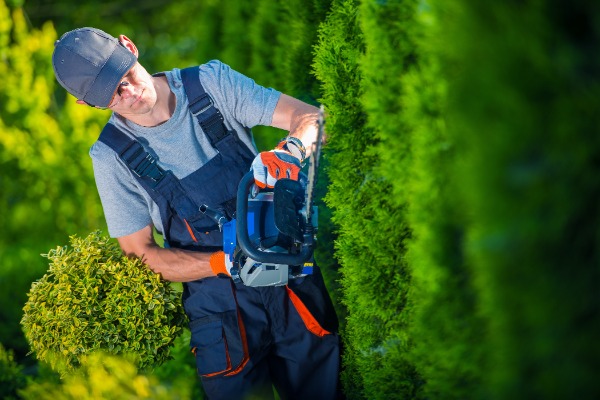
Privacy hedges are often planted to create a living wall between your property and the outside world. Whether you're trying to block neighboring homes or create a more secluded backyard, the effectiveness of your hedge depends largely on how it's maintained.
Improper trimming can cause gaps, thinning, and uneven growth that reduce privacy over time. A hedge that receives the right type of maintenance develops into a dense, uniform barrier, and this blog post will teach you how to trim properly to create the best privacy hedges possible.
One of the biggest challenges with privacy hedges is keeping them full near the bottom. Many hedges start out dense when young but gradually lose foliage near ground level as they mature. This usually happens because upper branches begin shading the lower portions of the plant.
To prevent this issue, think of your hedge as a structure that needs sunlight from top to bottom. The lower branches should never be completely shaded by the upper canopy. Trimming in a way that allows light to reach all levels of the hedge helps maintain thick foliage throughout the entire screen.
Perfectly flat hedge surfaces may look appealing immediately after trimming, but an obsession with geometric perfection can actually work against the health of the plant. Repeatedly cutting every branch to the exact same height encourages growth only on the exterior surface.
Over time, this creates a shell of green foliage surrounding a sparse interior. If the outer growth is ever damaged or cut back, the bare interior becomes exposed.
Instead of focusing solely on creating perfectly straight edges, aim for a natural and balanced appearance. Small variations in branch length help sunlight penetrate deeper into the hedge and encourage stronger internal growth. The result is a screen that remains dense throughout rather than just looking good from a distance.
Many hedge problems begin when trimming is delayed too long. Once a hedge becomes overgrown, homeowners often feel compelled to remove large amounts of growth all at once. While this may restore shape temporarily, it can place significant stress on the plant.
A better strategy is to perform light maintenance on a regular basis. Small adjustments throughout the growing season allow you to maintain the desired size without shocking the hedge.
Consistent trimming offers several advantages:
Not every branch should remain part of the hedge indefinitely. As plants mature, certain branches become damaged, diseased, overcrowded, or poorly positioned. Leaving these branches in place can affect the overall quality of the screen.
During each trimming session, spend a few minutes inspecting the hedge for branches that are no longer contributing to healthy growth. Removing these problem areas often improves the appearance and performance of the hedge more than simple shaping alone.
Pay particular attention to:
Not all privacy hedges require the same trimming schedule. Some varieties grow several feet per year, while others develop much more slowly. Applying the same maintenance approach to every hedge can produce disappointing results.
Fast-growing species often benefit from multiple trims each season to maintain a neat appearance and prevent excessive size increases. Slower-growing varieties generally require fewer cuts and can be damaged if over-pruned.
Understanding your specific hedge type allows you to develop a maintenance routine that supports healthy growth while preserving its screening ability.
When trimming a privacy hedge, appearance should always come second to function. While a neatly shaped hedge is attractive, its primary purpose is to create a visual barrier. Before removing any growth, consider whether the cut will improve or reduce privacy.
Sometimes allowing a hedge to remain slightly wider or taller provides significantly better screening. Likewise, preserving dense side growth may be more beneficial than creating perfectly flat surfaces.
Every trimming decision should support the long-term goal of maintaining a continuous, uninterrupted screen between your property and the surrounding area.
A successful privacy hedge is rarely the result of occasional heavy pruning. Instead, it comes from consistent attention, thoughtful trimming, and an understanding of how the plants naturally grow.
When you focus on maintaining density, preserving lower growth, improving airflow, and making gradual adjustments over time, your hedge becomes far more effective as a property screen. The result is a healthier landscape feature that provides year-round privacy while enhancing the overall appearance of your yard.
Q: How often should privacy hedges be trimmed?
A: Most privacy hedges benefit from at least one major trimming each year, although fast-growing varieties may need several light touch-ups throughout the growing season.
Q: Why is my hedge becoming thin at the bottom?
A: Lower branches often thin out when they don't receive enough sunlight. Improper shaping and excessive top growth commonly contribute to this problem.
Q: Can trimming make a hedge grow thicker?
A: Yes. Proper trimming encourages branching, which helps create denser foliage and a more effective privacy screen.
Q: Is it okay to cut a hedge back severely?
A: Some hedge species tolerate hard pruning, while others may struggle to recover. Large reductions are generally best performed gradually over multiple seasons.
Q: What time of year is best for hedge trimming?
A: Most privacy hedges respond well to trimming during active growth periods, typically in late spring and summer. Avoid major trimming immediately before winter.
Q: Should I remove dead branches whenever I see them?
A: Yes. Dead, damaged, or diseased branches can be removed whenever they are noticed to improve both appearance and plant health.


